
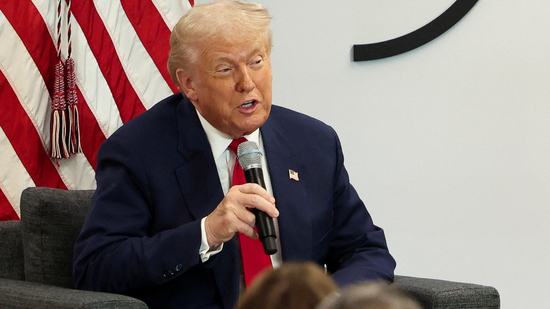
After indirectly seizing control over Venezuela, US President Donald Trump has revived the Greenland dispute by demanding that Denmark hand over Greenland to the United States.
SNPNEWS.IN News (Gurmail Kamboj): US President Donald Trump’s second term has been the subject of discussion from the very beginning due to controversial statements and decisions. After arresting Venezuelan President Nicolás Maduro and his wife on January 3 on charges of drug trafficking, narco-terrorism, and arms smuggling (following an attack), and bringing them to the United States, President Trump has reiterated his demand to purchase or control Greenland, Colombia, Cuba, and Mexico, calling them an “absolute necessity.”
The discussion of the US purchasing or taking control of Greenland from Denmark began in 2019 and has intensified during Donald Trump’s second term. Greenland is an autonomous territory of Denmark, considered part of Denmark, but Greenland has the right to make its own decisions. Trump claims that Greenland is essential for US national security (against Russia and China), especially in the Arctic region. He views it as a “big real estate deal.”
Trump has repeatedly said that the US will acquire it “one way or another,” which initially included threats of military force (later dismissed). Leaders of Denmark and Greenland have clearly stated that Greenland is not for sale. Greenland’s Prime Minister Mette Frederiksen has said they want to remain with Denmark and the European Union.
During the World Economic Forum in Davos (Switzerland), after a meeting with NATO Secretary General Mark Rutte, Trump announced that a “framework” for a future deal on Greenland has been formed. Trump said the US would get “total access” (permanent and without time limits), and the US would not use military force to take Greenland. European NATO members showed unity and acknowledged Arctic security as a common issue, but rejected US pressure.
Read It: America Attacks Venezuela, President Arrested
After officially taking control of Venezuela, US President Donald Trump did not rule out military force or economic pressure (tariffs). He called Greenland an “absolute necessity” for the US and essential to strengthening NATO.
● After Trump’s repeated comments on the Greenland issue, on January 6, 7 European countries (Denmark, France, Germany, UK, Norway, Sweden, Finland) issued a joint statement saying that in the Greenland dispute, “the people of Denmark and Greenland should decide.” They emphasized respect for international law and sovereignty. Danish Prime Minister Mette Frederiksen warned that an attack on Greenland would end NATO and challenge Article 5 (collective defense).
● On January 9, 2026, Trump said that to resolve the Greenland dispute, the US would “do anything, whether they like it or not.” The President said, “I want to make an easy deal, but if the easy way doesn’t work, we’ll do it the hard way.” This is necessary to stop Russia and China.
● On January 13, NATO Secretary General Mark Rutte said the US has an “absolute commitment” to NATO and more joint work is needed on Arctic security. Recalling Trump’s earlier statements, he said defense against Russia and China in the Arctic should be increased, but there will be no compromise on sovereignty.
● On January 15, Denmark increased its military presence in Greenland, and NATO countries like Germany, France, Sweden, Norway, Netherlands, and Finland also sent small numbers of military personnel (for joint exercises). This was a joint signal against Trump’s threats.
● On January 17, 2026, Trump posted on Truth Social that he would impose 10% to 25% tariffs on NATO nations (Denmark, Norway, Sweden, France, Germany, UK, Netherlands, and Finland) starting February 1 (increasing until June), unless a deal is reached for the “complete and total purchase” of Greenland. He said these countries are going to Greenland for “strange purposes.”
● On January 18, the same 8 countries issued a joint statement saying that the US President’s tariff threats are putting transatlantic relations at risk and could lead to a “dangerous downward spiral.” They expressed full solidarity with Denmark and Greenland and acknowledged Arctic security as a common issue.
● On January 20, 2026, when asked by reporters at the White House how far he would go, Trump said, “You’ll find out.” He dismissed European threats and called Greenland “imperative” for the US.
● On January 21, 2026 (at the World Economic Forum in Davos), in his speech, Trump for the first time clearly stated that he would not use military force. He said, “I won’t have to use force, I won’t use force… We just want Greenland.” He demanded “immediate negotiations” and said purchasing or controlling Greenland is essential.
The same day, after a meeting with NATO Secretary General Mark Rutte, Trump announced on Truth Social that they had formed a “framework of a future deal” for Greenland and the entire Arctic region. Because of this, he withdrew the tariff threat (not to take effect from February 1). He said this deal would be “much more generous” for the US and would provide “total access” to Greenland (without time limits). Later, in an interview with CNBC, he called it a “concept of a deal.”
During the World Economic Forum in Davos, Trump announced the “framework of a future deal” after his meeting with Rutte and withdrew the tariff threat. After the meeting, Rutte said no discussion on sovereignty took place. He said the deal focuses on increasing defense in the Arctic (against Russia/China) and NATO members will have to do more work.
● On January 22, Denmark and Greenland said sovereignty is a “red line” and they are unaware of the details of the deal proposed by the President. They appeared to distance themselves from Trump’s claim of a “framework of a future deal.” Meanwhile, a NATO spokesperson said Rutte did not offer any compromise on sovereignty.
● On January 22-23, 2026 (on the return from Davos aboard Air Force One), when reporters asked about the deal, Trump gave no details, only saying negotiations are ongoing and the deal will be “very good.” He completely rejected the use of military force and focused on Arctic security.
● On January 23, European leaders said Trump’s backdown (on tariffs and military threats) taught a lesson that “pushback” works. NATO countries focused on Arctic security and said military planning awaits political directions.
Italian Prime Minister Giorgia Meloni, (who known for her close ties to US President Donald Trump) wrote on Truth Social/X after Trump withdrew his threat to impose tariffs on NATO countries: “I welcome President Trump’s announcement to suspend tariffs… As Italy has always supported, it is fundamental to continue to promote dialogue between allied nations.”
Overall, NATO countries (excluding the US) remained firm on protecting sovereignty, increased military presence, and showed unity through joint statements. After the Davos meeting, claims are being made that tension in the Greenland issue has decreased and everyone’s focus has shifted to joint defense in the Arctic, but Greenland’s sovereignty remains intact. Talks continue to resolve the issue.