
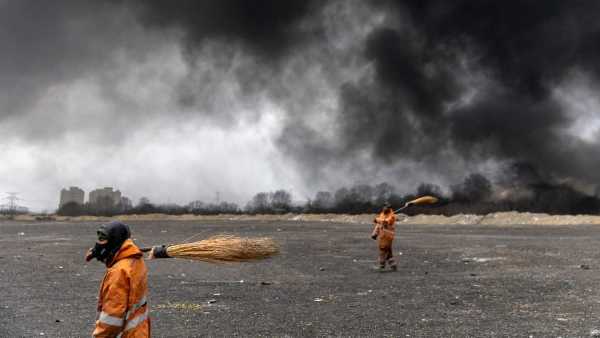
The most terrifying form of the Israel-US-Iran war was seen on Saturday when Israel and Iran targeted each other’s crude oil supplies.
SNPNEWS.IN News (Gurmail Kamboj): The Israel-US-Iran war, which has been ongoing since October 2025, has now taken a highly alarming turn. Following the joint US-Israel attacks on February 28, which resulted in the deaths of Iran’s Supreme Leader Ayatollah Ali Khamenei, his family members, officials, and ministers, the situation appears to be heading toward extreme crisis. From February 28 until today, more than 2,000 people, including 160 schoolgirls, have been killed.
Between February 28 and March 6, claims were being made that the Israel-US-Iran war would stop. During this period, Iran apologized to neighboring Arab countries (where it had targeted US military bases on a large scale) and stated that it would not carry out attacks again until Arab countries’ territory is used to attack Iran.
Iran threatened to block the Strait of Hormuz and has effectively closed it in practice. This route is the world’s most important chokepoint for oil trade, through which approximately 20% of global oil (about 20 million barrels per day) and a large amount of LNG (liquefied natural gas) passes. It connects the Persian Gulf to the Indian Ocean.
Read it: Gulf Countries on Iran’s Target; Attempts to Target American Fleet
On March 2, 2026, senior IRGC (Iranian Revolutionary Guards Corps) official Ibrahim Jabari announced: “The strait is now closed. If any ship attempts to pass, the Revolutionary Guards and Navy will set it ablaze.” Iran carried out drone and missile attacks on some ships, causing commercial vessels to abandon the route.
Meanwhile, on Saturday, March 7, Israel attacked Iran’s Shahran oil depot, Aghdasieh oil warehouse, Tehran refinery, Karaj oil depot, and other oil depots and fuel storage sites, causing massive destruction. Following Israel’s attacks, huge clouds of smoke enveloped the areas due to fires at these sites, and a situation of “black rain” (oil-mixed rain) emerged in Tehran and surrounding regions. The WHO and other social organizations have described this as deadly for humans. Four people were killed in this attack.
In response to Israel’s attacks, Iran launched missile strikes on Israel’s Haifa refinery and other locations. In addition, attacks were carried out on a desalination plant in Bahrain and other regional targets. Furthermore, Iran targeted Bahrain’s BAPCO oil refinery, Saudi Arabia’s Shaybah oil field, Aramco facilities, and areas near Riyadh.
The heat of the Israel-US-Iran war is now visibly affecting the entire world. Reports of Israel targeting Iran’s oil sites have raised concerns worldwide. Crude oil prices have reached $110-120 per barrel, and if the situation does not improve soon, there is a possibility it could go up to $200 per barrel. An increase in petrol, diesel, and LPG prices is anticipated across the world, including in India, along with the likelihood of shortages in petrol, diesel, and LPG supplies.
This is the first major disagreement (significant disagreement) between the US and Israel since the start of the war, following attacks on Iran’s fuel storage sites. US officials and the White House expressed surprise and displeasure at the scale/breadth of the attacks.
A US spokesperson expressed anger after Israel’s attacks on Iran’s fuel storage sites, saying: “We don’t think it was a good idea.”
According to an Israeli official, the US response was something like “WTF” (What the fuck?), which was a highly angry and sudden expression of displeasure.
President Donald Trump also did not like these attacks. One of his advisers said: “The president doesn’t like the attack. He wants to save the oil. He doesn’t want to burn it. And it reminds people of higher gas prices.”