
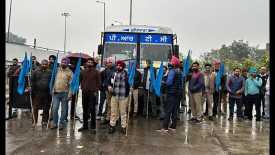
The Punjab government is fully determined to pave the way for privatization of public transport by bringing loss-making government bus routes under the Kilometre Scheme.
SNPNEWS.IN (Gurmail Kamboj) – 29 November 2025Following orders from the Punjab government, all contractual/temporary employees working in Punjab Roadways, PRTC, and PUNBUS have been suspended with immediate effect. The decision was taken on the evening of 28 November 2025 and implemented on 29 November.
Actually, the Punjab government has prepared to allow private bus operators to run buses on more than 1,500 loss-making routes of Punjab Roadways and PUNBUS under the Kilometre Scheme.
The controversy over the Kilometre Scheme first surfaced in May 2016 during the Akali-BJP government, when the then Transport Minister Ajit Singh Kohar announced the operation of private buses on 700 loss-making routes under this scheme. Transport employees went on strike against this decision and knocked on the doors of the Punjab & Haryana High Court in June 2016.
When employees observed a 3-day complete shutdown from 27 June 2016, the government was forced to withdraw the decision. In August 2016, the government again issued tenders, but after threats of another strike, the tenders were cancelled.
On 16 December 2016, the Punjab & Haryana High Court delivered a historic judgment (CWP No. 17304 of 2016), clearly stating:
“Handing over government permits to private operators under the Kilometre Scheme is illegal as it violates Sections 19 and 20 of the Road Transport Corporations Act, 1950.”
After the Aam Aadmi Party (AAP) government came to power under Bhagwant Mann, in July 2022, PRTC again invited tenders under the Kilometre Scheme for 219 routes. Contract workers started protesting, fearing their jobs would be lost once private buses arrived. This led to the first major strike under the AAP regime.
In January 2023, tenders were floated twice, but only two individuals participated, exposing the scheme’s failure. Private operators cited free travel for women and the High Court judgment as reasons for staying away.
In July 2025, the first major strike against privatization took place, after which the government assured that no employee would be removed from service.
From the beginning of October 2025, talks of issuing tenders for over 1,500 routes under the Kilometre Scheme intensified. Seeing this, transport employees observed a statewide shutdown on 14 October. On 22 October, unions issued an ultimatum to block national highways if AC bus tenders were not cancelled. On 23 October, protests were held over non-cancellation of Volvo HVAC bus tenders, and a major strike was threatened for 31 October.
The dispute between the Punjab Transport Department and employees escalated from early November 2025. After the strike was postponed on 17 November, a 3-day strike was announced on 22 November in protest against the Kilometre Scheme and privatization.
Read It: Gurdaspur Pesticides Association On Strike From Today, April 21
On 27 November 2025, the Transport Department issued AC bus tenders in Chandigarh. This triggered violent protests – attempts at self-immolation in Mansa, clashes with police, and violence in Sangrur and Dhuri (Dhuri SHO injured).
On 28 November 2025, despite protests, tenders for 180 HVAC diesel-engine buses were opened across the state. FIRs were registered against 10 union leaders.
On 29 November 2025, declaring the strike illegal and citing financial loss to the government, more than 16,000 contractual employees were suspended. As a result, all depots in Punjab have been shut down and public bus services have completely collapsed. The government has planned to open tenders for another 200 PRTC buses on 2 December. Unions have threatened to block national highways.
According to the government’s plan, tenders have been issued to hire 142+ buses (100 for PUNBUS/Roadways + 42 for PRTC) on inter-city routes. Under the scheme, private operators will pay the government ₹42–₹52 per kilometre and will bring their own drivers and conductors.
The government claims it wants to reduce the massive losses of transport corporations through the Kilometre Scheme, but this directly threatens the jobs of 16,000–18,000 contractual employees. This fear has fuelled continuous strikes over the past six months, and now the government has taken the toughest step by suspending all of them. Subcribe Our YouTube Channel