
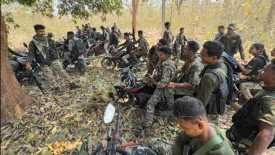
The Naxal movement, which began in West Bengal, has now, after 58 years, been confined to a very limited area. Terrified by the relentless operations of security forces, Maoist leaders are seeking time from the government until February 2026 to surrender collectively.
SNPNEWS.IN News (Gurmail Kamboj): The Naxal movement that started on 23 May 1967 from the village of Naxalbari (Darjeeling district, Siliguri subdivision, West Bengal) has now shrunk from affecting 126 districts across the country to just 12–13 districts. What began in 1967 as a revolt against the economic exploitation of poor farmers, sharecroppers, and laborers by landlords spread from Naxalbari to Sikkim, Andhra Pradesh (Srikakulam), Bihar, Odisha, and Maharashtra.
Leaders Charu Majumdar, Kanu Sanyal, and Jangal Santhal came together to form an organization against the economic and mental oppression of the poor, farmers, and laborers by landlords. On 25 May 1967, police opened fire on a farmers’ meeting, killing 11 people (including 9 women and children). This triggered violent retaliation by peasants against landlords.
From that point, a cat-and-mouse game began between the Maoists and the administration. In the 58-year period, thousands of security personnel and Maoists have been killed, surrendered, or arrested. The struggle that started for the rights of the poor, laborers, and farmers once enabled Maoists to run parallel governments in more than 126 districts across West Bengal, Maharashtra, Andhra Pradesh, Chhattisgarh, Telangana, Odisha, Jharkhand, and Madhya Pradesh. But due to continuous security operations, their influence is now confined to just 12–13 districts along the Maharashtra–Chhattisgarh border.
Read It: Andhra Pradesh: Naxal couple with ₹1.80 crore bounty killed
Citing the Maharashtra–Madhya Pradesh–Chhattisgarh (MMC) zone of the Maoists, leader Anant has written letters to the Chief Ministers of all three states requesting time until 15 February 2026 for a collective surrender. In the letter, they have demanded that the administration and security forces halt all operations during this period so that they can contact their scattered cadres in the jungles and convince them to surrender. They have also asked the government to ensure social dignity and respect for former Maoists who lay down arms and join the mainstream.
The government has described the letter as a “genuine but desperate step”. Maharashtra Police said, “The doors for surrender are open, but operations will continue.” Chhattisgarh Deputy Chief Minister Arun Sao stated, “We are committed to ending Naxalism; those who surrender will get security and benefits under rehabilitation schemes.” All three states have strengthened their rehabilitation policies; for example, Chhattisgarh’s 2025 policy provides ₹1 crore development fund to villages from where cadres surrender. In Telangana too, 37 Maoists have surrendered recently.
Read More: 4 Naxalites, Including Three Women, Killed In Balaghat Encounter
To crush Maoist resistance, the central government is relying on major operations like Operation Kagar and Operation Black Forest. In the last two years, these operations have resulted in:
● Over 2,000 Maoists killed (including several top leaders)
● Thousands arrested
● Hundreds of cadres, including senior leaders, surrendering
Union Home Minister Amit Shah has set a target to make India completely free from Maoism by 31 March 2026. Recently, during the Bihar Assembly election campaign, Prime Minister Narendra Modi also reiterated that all states of India will be made Naxal-free by 31 March 2026.