
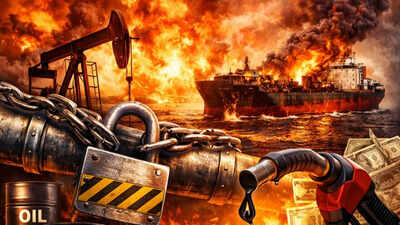
After Prime Minister Narendra Modi’s address to the Lok Sabha and Rajya Sabha on 24 March, discussions about an “energy lockdown” have begun across the country.
SNPNEWS.IN News (Gurmail Kamboj): The US-Israel-Iran war, which started on 28 March, is emerging as a major crisis for the entire world. After 28 days since the war began, the threat of a global energy crisis has taken shape. Oil prices have reached $100-120 per barrel. This impact is clearly visible on Asian and African countries. As a result, talks of imposing an energy lockdown have started worldwide. Due to the situation in the Middle East, inflation, rationing, shortage of fertilizers, and food crisis are increasing at the global level.
Prime Minister Narendra Modi, while addressing the Rajya Sabha and Lok Sabha on 24 March, stated that the situation in the Middle East is affecting the entire world, and India too cannot escape this crisis. The country is facing conditions similar to the COVID-19 lockdown. Therefore, the people of the country will have to unite and overcome this difficult time. After the Prime Minister’s speech, discussions about the government taking some strict steps have intensified in view of the situation.
Talks of a large-scale lockdown in the country have begun, due to which an atmosphere of panic has been created among the people. On the night of 25 March, long queues formed at petrol pumps in Gujarat, Punjab, Haryana, Delhi, Uttar Pradesh, Maharashtra, Karnataka, Bengal, and across the entire country. Many petrol pumps across the country had to be closed due to running out of fuel. Earlier, in the initial phase of the war, long queues had formed across the country due to a shortage of gas, but now the situation appears extremely worrying. This has increased the risk of rising inflation, shortage of food grains, unemployment, and energy crisis in the country.
Read It: Israel-US Iran War: Is Country face crisis of shortage of fertilizers & Insecticide?
Experts, looking at the situation, are predicting an energy lockdown in India as well as around the world. Oil and gas production units in Gulf countries are being targeted during the Israel-US-Iran war, and due to the closure of the Strait of Hormuz (through which 20-30% of the world’s oil passes), oil prices have reached $100-114 per barrel. The UN chief has called this situation “completely out of control.”
After the shortage of petrol, diesel, and gas in India, the biggest problem could be the shortage of fertilizers (Urea/DAP/MOP/Sulphur etc.) due to disruption in imports from Gulf countries (because of halted supply of natural gas LNG required for fertilizer supply and urea production). This could lead the country to face risks of food shortage, inflation, and economic crisis.
Apart from China, the situation in neighboring countries including India – Pakistan, Bangladesh, Nepal, Sri Lanka, Japan, Thailand and other Asian countries – is also very worrying. In addition to holidays in offices and schools, efforts are being made to save energy. Along with rising inflation and unemployment, security forces have been deployed at oil depots in many countries. There is a fear of famine-like conditions emerging in African countries. The impact has started showing on transport and industries.
Thousands of flights in the Middle East have been cancelled since the start of the war from America till now. United Airlines (a major US airline) has announced that it will reduce approximately 5% of its flights in the second and third quarters of 2026 (April to September). America will not be directly affected by this war because it produces enough oil and gas for its own needs, but crude oil prices in the global market are touching the sky, which will put some burden on the pockets of Americans.
For Australia, England, Germany, and France as well, the US-Iran-Israel war is turning into an economically losing deal. The biggest problem for European countries could arise due to the shortage of gas, as supplies were already affected due to sanctions on Russia earlier.
China (until August 2026) and Russia (until 21 April) have banned fertilizer exports, which could become a headache for India and other Asian and African countries, as Russia controls about 40% of the world’s ammonium nitrate trade. India and many Asian and African countries import fertilizers on a large scale from Russia. Due to the shortage of fertilizers, food production in Asia and Africa may decrease. Europe and America are also affected by inflation, but Asia is facing the biggest shock.
The situation in the Middle East is the most serious. In Iran and other Gulf countries, there has been massive destruction, hundreds of deaths, economic hardship, and oil production and exports have come to a complete halt. Israel has suffered major damage due to Iranian missiles. The current war has spread to Lebanon and Yemen as well.
On 25 March 2026 (Wednesday) at 5 PM in the evening, an all-party meeting was held in the Parliament House. It was called by the government to discuss the West Asia crisis, i.e., the Iran-Israel-America war and its impact on India. Defence Minister Rajnath Singh presided over it. Home Minister Amit Shah, External Affairs Minister S. Jaishankar, Finance Minister Nirmala Sitharaman, Petroleum Minister Hardeep Singh Puri, Parliamentary Affairs Minister Kiren Rijiju, and leaders of all parties except TMC were present.
After the meeting, the government issued a statement saying that the situation is under control and there is nothing for the people to panic about. Rajnath Singh and other ministers assured that with national unity and preparedness, this challenge will be overcome.