
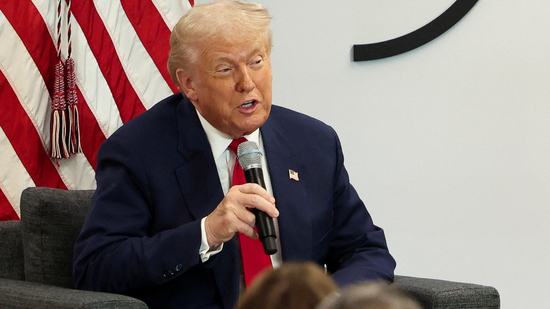
US President Donald Trump and Iranian President Masoud Pezeshkian have digitally signed a 14-point peace agreement, officially implementing it.
SNPNEWS.IN News (Gurmail Kamboj): The war that erupted on 28 February between the United States, Iran, and Israel turned the Gulf region into a battlefield. During the conflict, Iranian Supreme Leader Ayatollah Ali Khamenei, his associates, thousands of innocent Iranians, and hundreds of soldiers from the three countries were killed. Trillions of rupees worth of assets were destroyed. The ceasefire that came into effect on 8 April has now been officially implemented after US President Donald Trump and Iranian President Masoud Pezeshkian digitally signed the 14-point peace agreement for 60 days.
On 28 February, Israel and the United States jointly carried out missile strikes on Iran’s capital, Tehran, under “Operation Lion Roar” and “Operation Epic Fury.” These attacks killed Iranian Supreme Leader Ayatollah Ali Khamenei, senior government officials, and other leaders. In addition, a school in Iran was targeted during the joint operation, resulting in the deaths of hundreds of children and civilians. The US and Israel also targeted Iran’s largest gas production facility, the South Pars Gas Field, along with several energy production units and public infrastructure in an attempt to cripple Iran’s economy.
The 14 Major Conditions of the US-Iran Peace Agreement are as follows:
● All military actions, airstrikes, and firing between the two countries and their allies on all fronts have been permanently halted with immediate effect.
● The Strait of Hormuz, the world’s most important oil route, has been reopened for commercial shipping, which will help restore global oil supplies.
● Iran will clear all sea mines laid in the Strait of Hormuz within the next 30 days to ensure safe passage for ships.
● Iran will not charge any taxes, fees, or tolls on any commercial or cargo ships passing through the Strait of Hormuz for the next 60 days.
● The United States will fully lift its naval blockade on Iranian ports within 30 days.
● Within 30 days of the agreement, the US will withdraw its forces from areas near Iran and return to the pre-war position.
● Iran has agreed to dilute its stock of highly enriched uranium and reduce it to the 3.67% level.
● Until the next final talks, Iran will freeze the expansion of its nuclear program at current levels.
● The entire process of reducing uranium enrichment and freezing the nuclear program will occur on Iranian soil under the direct supervision of the International Atomic Energy Agency (IAEA).
● Iran has officially reiterated that it will never develop or acquire nuclear weapons in the future.
● The US Treasury Department will immediately issue waivers on sanctions related to Iranian crude oil exports, banking transactions, shipping, and insurance sectors.
● The US will issue necessary legal licenses to unfreeze Iranian funds and assets held in foreign banks so they can be made available for Iran’s use.
● A special economic plan worth $300 billion will be prepared for the reconstruction of Iran’s infrastructure.
● These 14 points constitute an initial framework (MoU). Both countries will resolve all disputed issues within the next 60 days and prepare a permanent “final peace agreement.”
Read it: Ceasefire: Trump stops war, Iran tells people to celebrate.
In response to the attacks, Iran’s IRGC completely closed the Strait of Hormuz — a critical passage responsible for 20% of the world’s oil and gas supply. It also targeted areas near Israel’s Dimona nuclear reactor and struck US military bases in Gulf countries on a large scale, causing trillions of dollars in losses to the United States. The war created fears of a global energy shortage, which led to rising inflation worldwide.
NATO countries refused to support the US in the war, and due to domestic pressure, President Donald Trump wanted to withdraw from the conflict. Despite threats to destroy Iran, he announced a two-week ceasefire from 8 April. It was extended several times. Minor clashes continued until President Trump announced the peace agreement on 14 June.
Some Republican leaders in the US have called this the biggest foreign policy blunder in American history, arguing that it has not fully neutralized Iran’s nuclear ambitions. Meanwhile, Israel was not part of the agreement negotiations. Israel has clearly stated that it is not bound by this deal and remains fully free to take action against Iran or Hezbollah for its own security.
Deep disappointment, shock, and anger are being expressed in Israeli political and military circles regarding this agreement. Israeli media and experts are calling it America’s “catastrophic capitulation.” Israel’s far-right National Security Minister Itamar Ben-Gvir said, “This deal does not apply to Israel at all” and “We are not Trump’s slaves.” Israel is completely independent to make decisions for its security.
Prime Minister Benjamin Netanyahu has reiterated that Israel’s main goal remains unchanged: “Iran will never have nuclear weapons.” Israel was completely sidelined from the negotiation process. The once-strong relationship between Netanyahu and Trump is now under significant political strain due to this deal. US Vice President JD Vance has also strongly signaled to Israel to follow the terms of the agreement.
President Donald Trump personally urged Netanyahu to “act more responsibly in Lebanon” and condemned recent Israeli attacks on Beirut, saying they threaten the peace process.
According to the agreement, military operations in Lebanon should stop, but the Israel Defense Forces (IDF) have announced they will not withdraw troops from the “security zone” created in southern Lebanon (approximately a 10-kilometer radius).
There is no mention of the Gaza Strip in this entire peace agreement. While Iran strongly pushed to protect its key ally Hezbollah in Lebanon, Hamas in Gaza was not included in the deal. Israel’s military control in Gaza continues to expand (Israel currently controls roughly 64–70% of Gaza), and military operations there are continuing without any pause.
As per the agreement, a $300 billion fund is to be created for Iran’s reconstruction. The US has refused to contribute, meaning the financial burden is likely to fall on wealthy Gulf countries such as Saudi Arabia and the UAE. While these countries have agreed to invest, they are concerned that Iran might use the funds to build weapons or strengthen proxy groups like the Houthis or Hezbollah, which could threaten regional security. They have therefore demanded strict international oversight on the use of this fund.
The peace agreement was finalized on 18 June during the G7 Summit at the Palace of Versailles in France. US President Donald Trump and Iranian President Masoud Pezeshkian signed the 14-point agreement. It is only an initial framework (MoU). Both sides will hold talks over the next 60 days to resolve all complex issues and prepare a final agreement. The final deal will receive international recognition through a binding resolution by the United Nations Security Council (UNSC).